
Learning Through Experience
Secure the Legacy
A Board-Level Guide to Family Business Succession Planning
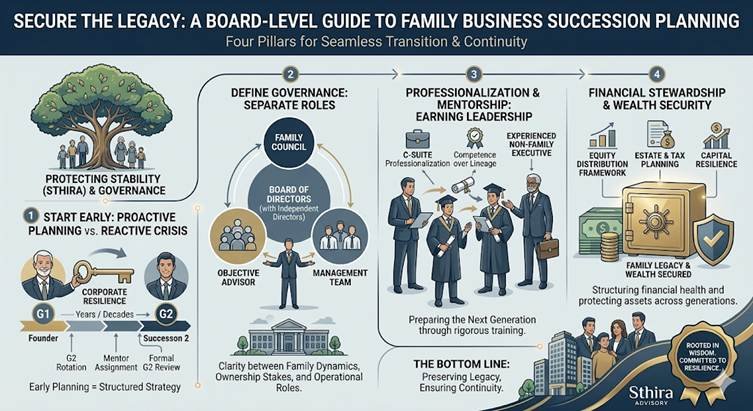
Family-owned enterprises form the backbone of many economies, but they face a unique and critical vulnerability: the transition of leadership and ownership between generations. Statistics show that very few family businesses successfully navigate the transition to the second or third generation.
For the board of directors, succession planning is not merely a family matter; it is a fundamental governance responsibility. A poorly managed transition can destroy shareholder value, alienate key non-family executives, and jeopardize the stability (Sthira) built over decades.
Grounded in over 30 years of corporate finance wisdom, Sthira Advisory provides a strategic framework for family business transitions that ensures continuity, professionalization, and resilience.
Here is how boards can proactively manage family business succession:
1. Start Early: Proactive Planning vs. Reactive Crisis
The most common mistake is waiting too long. Succession planning should begin years, if not a decade, before an expected transition. This provides ample time to mentor successors, professionalize the management structure, and implement formal governance without the pressure of an impending crisis. Early planning shifts the process from an emotional family event to a structured strategic initiative.
2. Define Governance: Distinguishing Family, Ownership, and Management Roles
Complexity arises when family dynamics intersect with business operations. Effective succession requires clear differentiation between family roles, ownership stakes, and management responsibilities. This involves establishing formal governance structures, such as Family Councels or a robust Board of Directors with independent directors, to facilitate objective decision-making and build consensus among stakeholders.
3. Professionalization & Mentorship: Preparing the Next Generation
Leadership should be earned through competence, not just lineage. The board must oversee a rigorous process for identifying and preparing successors. This includes providing mentorship, rotating them through key business functions, and, crucially, encouraging them to gain external experience outside the family business. Professionalizing the C-suite—even with non-family executives—ensures operational continuity during the transition.
4. Financial Stewardship & Wealth Security
A succession plan must address the complex financial implications of the transition. This includes structuring equity distribution, planning for estate taxes, and ensuring the business maintains sufficient capital stewardship and operational runway. We work with families to create robust financial frameworks that protect the corporate legacy while securing the family’s wealth across generations.
The Bottom Line Inorganic growth through M&A is a profound business transformation. When guided by independent oversight and rooted in wisdom, an acquisition stops being a risky gamble and becomes a calculated, strategic leap forward.
Family business succession is a complex journey, not a singular event. By implementing a structured governance framework rooted in foresight and objective advice, families can ensure their enterprise survives the transition, preserving both their legacy and their stability.