
Learning Through Experience
The Boardroom Sentinel
Navigating the 2026 Polycrisis with Strategic Foresight
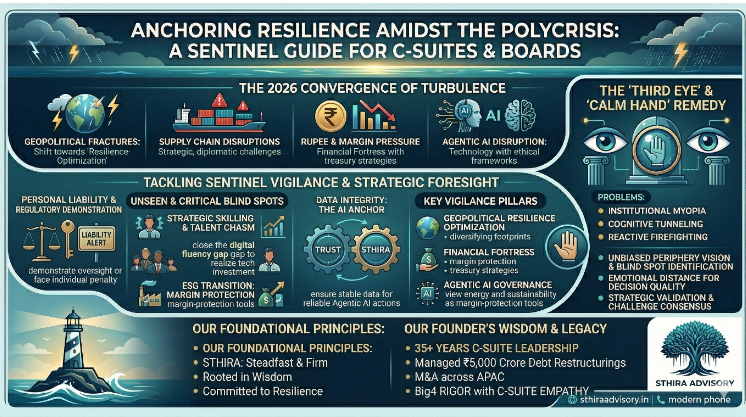
In the corporate landscape of 2026, the traditional business cycle has been replaced by a “polycrisis”—a tangled web of geopolitical shifts, technological upheavals, and economic volatility. For C-Suite leaders and Board Directors, the mandate has shifted from simple oversight to sentinel leadership. To navigate this era, boards must be hyper-vigilant, looking not just at the visible storms on the horizon, but at the sub-surface currents that can sink even the most storied enterprises.
The Convergence of Visible Turbulence
Today’s leadership must contend with a specialized set of pressures that test the limits of traditional risk management:
- Geopolitical Fractures & Supply Chain Fragility: We have moved toward “Resilience-Optimization”. Supply chains are no longer just logistical challenges; they are diplomatic ones. Diversifying geographical footprints before the next trade barrier rises is now a fiduciary duty.
- The Rupee and Margin Fortress: With the Rupee testing new lows against the USD, “business as usual” budgeting is a relic. Leaders must build a financial fortress by anticipating margin compression and utilizing sophisticated treasury strategies that prioritize capital preservation.
- The AI Disruption: We are now in the era of Agentic AI—systems that take actions, not just offer suggestions. Boards must ensure that technology changes do not outpace the company’s ethical frameworks or data integrity protocols.
The Hidden Blind Spots: Sub-Surface Currents
While the visible storms grab headlines, the truly vigilant Board must address four critical “blind spots” that often go unnoticed until it is too late:
1. The Regulatory Cliff & Personal Liability
In 2026, the shift from “comply or explain” to “demonstrate or be penalized” is absolute. Regulators are scrutinizing Board Minutes to see if Directors actually challenged management on AI ethics and climate risks. Oversight failure is no longer just a corporate risk; it is a personal liability risk for every director in the room.
2. The Talent Chasm
Technology doesn’t fail; people do. Organizations are facing strategic setbacks not because the AI isn’t powerful, but because the workforce lacks “Digital Fluency”. If the Board oversees a massive tech investment without an equivalent investment in upskilling, they are effectively funding a stranded asset.
3. Data Integrity: The Anchor for AI
You cannot have reliable AI without stable data. Agentic AI requires a level of data governance that transcends the IT department. Garbage-in, garbage-out now leads to automated, high-speed legal and financial disasters. Data integrity is now a core risk-mitigation pillar.
4. ESG as Capital Allocation
The era of ESG as a “marketing brochure” is dead. In 2026, sustainability is a Margin Protection tool. Transition risk—the vulnerability to rising energy costs and carbon taxes—is a CFO-level ledger item. Reducing energy dependence is no longer just “green”; it is a strategic hedge against a weakening Rupee.
The Necessity of the "Third Eye" and the "Calm Hand"
Promoters and Boards often operate in a “pressure cooker”. Proximity to the problem can lead to cognitive tunneling—a narrow focus on immediate firefighting that ignores long- term opportunities. This is where an external advisor becomes the “Third Eye”.
An advisor provides:
- Unbiased Periphery Vision: Identifying the blind spots—like the “Regulatory Cliff” or the “Talent Chasm”—that internal teams miss.
- The Calm Hand: When the Rupee drops or a supply chain breaks, internal emotions run high. A seasoned advisor brings the emotional distance and objective clarity required to make high-stakes decisions without panic.
- Validation and Challenge: Providing the stature to challenge the status quo and the wisdom to validate the path forward when the data is ambiguous.