
Learning Through Experience
Vridhi & Sthira
How M&A Propels Inorganic Growth Without Sacrificing Stability
April/May 2026
In a rapidly evolving global market, relying solely on organic growth can leave an enterprise vulnerable to more agile or better capitalized competitors. For companies looking to scale decisively, Mergers and Acquisitions (M&A) offer a powerful accelerator. However, executing a successful transaction requires far more than just capital—it demands executive guidance, deep financial wisdom, and an unwavering commitment to corporate resilience.
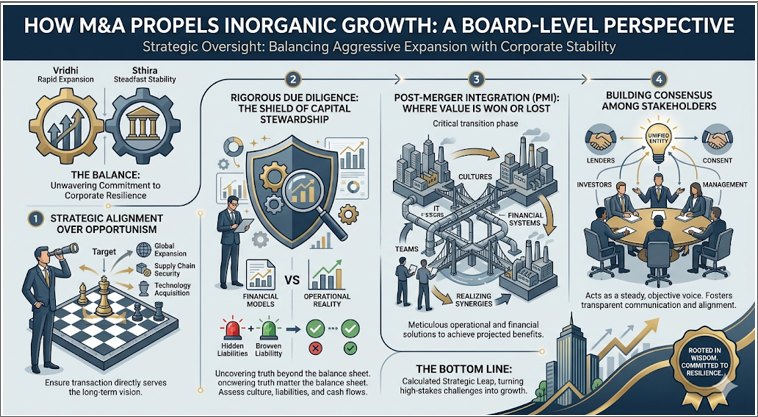
While M&A is a recognized catalyst for Vridhi (rapid, expansive growth), that growth can only be sustained if it is built upon a foundation of Sthira (steadfast stability). For the board of directors and the C-suite, navigating an acquisition means balancing the aggressive pursuit of market share with the defensive necessity of capital stewardship.
Here is how strategic, board-level counsel turns a complex transaction into a true engine for inorganic growth:
1. Strategic Alignment Over Opportunism
The most successful acquisitions are driven by a pre-defined corporate strategy, not merely by the sudden availability of a target. Does the acquisition secure a critical supply chain? Does it open a new geographic market? The board’s primary role is to ensure the transaction directly serves the long-term vision of the enterprise, preventing costly diversions that dilute shareholder value.
2. Rigorous Due Diligence:
The Shield of Capital Stewardship A target company’s financial models may look promising on paper, but uncovering the operational reality requires deep, investigative due diligence. It is essential to look beyond the balance sheet to assess cultural fit, hidden liabilities, and the true sustainability of cash flows. Effective due diligence acts as the ultimate shield, ensuring the acquiring firm does not overpay or inherit unmanageable risks.
3. Post-Merger Integration (PMI):
Where Value is Won or Lost The signing of the deal is not the finish line; it is the starting point. Successful PMI requires a meticulously planned operational and financial solution. It involves harmonizing distinct corporate cultures, aligning systems, and building consensus among newly merged leadership teams. The board must monitor this phase closely, ensuring the projected synergies are actually realized.
4.Building Consensus Among Stakeholders
A major acquisition often introduces friction among lenders, legacy investors, and management teams. A critical aspect of advisory is acting as a steady, objective voice in the boardroom. By fostering transparent communication, experienced advisors help unify stakeholders behind the new, combined entity.
The Bottom Line Inorganic growth through M&A is a profound business transformation. When guided by independent strategic counsel and rooted in wisdom, an acquisition stops being a risky gamble and becomes a calculated, strategic leap forward.
At Sthira Advisory, we partner with boards and executive teams to navigate the complexities of M&A, ensuring every transaction is structurally sound and strategically aligned. Rooted In Wisdom, Committed To Resilience.